
If you run a business in Houston and need software built, the first search is usually local. That instinct is sound, but “local” can mean several different things: a team in the same building, a sales office with developers elsewhere, or a firm that happens to list a Houston address. Which one you need depends on what you are building and how you like to work.
Here is what the Houston market looks like in numbers, what being local actually buys, and the questions that separate a good partner from a good pitch.
The Houston market, in published numbers
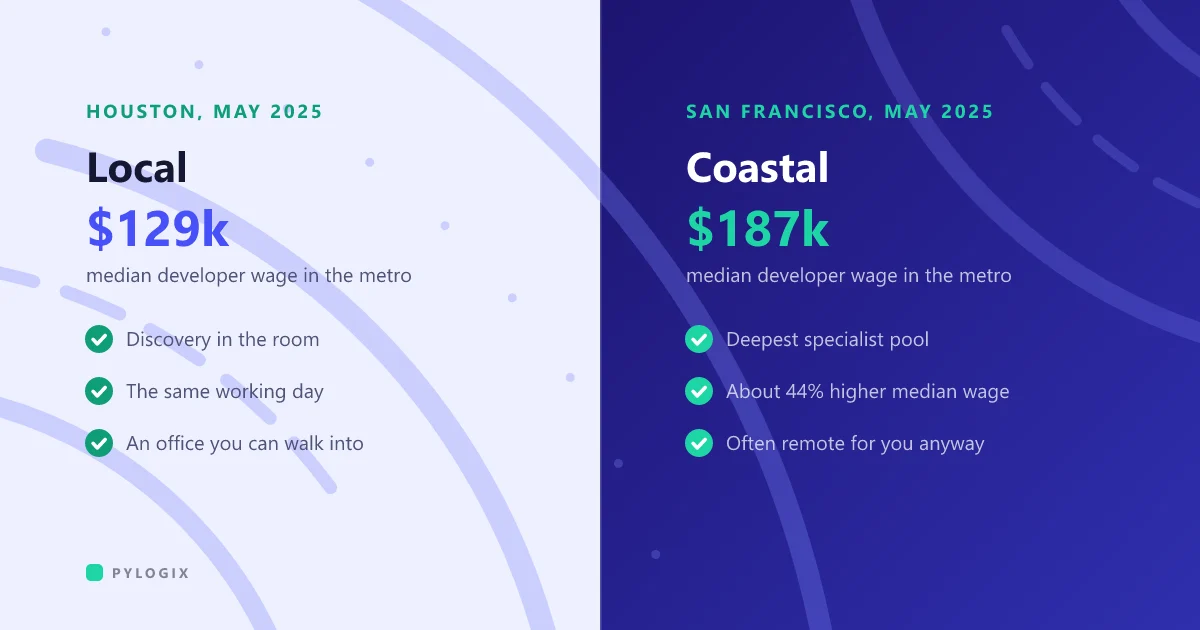
The Bureau of Labor Statistics publishes wages by metro area every year. The latest figures, for May 2025, put Houston below both the national median and the coastal tech centers, and level with Dallas and Austin.
Two practical consequences. Hiring in Houston costs less than hiring on either coast, which helps whether you build a team yourself or pay a local firm whose costs follow local wages. And the pool is deep enough that you are not forced to look elsewhere for common skills, though specialist roles, particularly in machine learning, are thinner, as the data scientist count shows.
To turn a wage into the cost of a working day, add benefits and payroll taxes and divide by the days actually available. We did that for the national figure in what custom software actually costs, which comes to about $820 a day. The same method on Houston’s median gives roughly $780.
What being local actually buys
Discovery in the room
The most valuable weeks of a project are the first ones, when someone watches your people do the job, sees the spreadsheet that runs the warehouse, and hears the exception everyone forgot to mention. That is far easier in person, particularly for operational software where the work happens on a floor, a site or a yard rather than at a desk.
We set out what that phase should produce in what actually happens in a software discovery phase.
The same working day
A question asked at 10am answered by lunchtime, rather than overnight. Decision speed is one of the strongest predictors of whether a project runs late, and the delay is usually on the client’s side. A shared time zone removes one source of it.
The signals are covered in why software projects run over budget.
Accountability you can walk into
When something goes wrong, a firm with an office you can visit and people who live where you do has more at stake locally. That is a soft benefit, and also a real one.
Notice what is not on the list: code quality. Nothing about a Houston address makes software better. Once discovery is done and the team is in a rhythm of releases every two or three weeks, most collaboration happens in tickets, pull requests and short calls, and the physical location of the developer matters very little.
Local, remote or hybrid
Fully local team
- Easiest discovery and workshops
- Same hours throughout
- Smallest pool for specialist skills
- Right for on-site, operational software
Fully remote team
- Widest choice of skills and rates
- Discovery is harder and often thinner
- Time-zone gaps slow decisions
- Right for well-specified work
Local lead, distributed delivery
- Someone local owns the relationship
- Delivery capacity where the skills are
- Works only if the lead is technical
- The common answer, done well or badly
The trade-offs of rate against distance are covered properly in onshore, nearshore, offshore. The short version: you are trading rate for communication overhead, and the overhead is paid in your own people’s time.
The hybrid model fails in one recognizable way: a local salesperson with no authority over a distant team. You hear confident answers in meetings and then wait days for the real ones. Ask to meet the people who will write and review the code, not only the people who will manage the account.
Questions to ask any Houston software company
- Who will actually write the code, and where are they? Names and roles, not “our team”. There is nothing wrong with a distributed team. There is something wrong with not being told.
- Can I meet the technical lead before signing? The person who will make the architecture decisions, not a pre-sales engineer who leaves after the contract.
- Who owns the code, the repositories and the cloud accounts? You should, from day one. See what you should own when a build ends.
- What does your estimate assume? A quote with no written assumptions cannot be compared with another one. See writing a brief that gets accurate quotes.
- How do you contract? Fixed price and time and materials protect different parties against different risks. See which contract actually protects you.
- Can I speak to a client whose project went wrong? Every firm has one. How they handled it tells you more than any success story.
The full checklist, beyond location, is in how to choose a custom software development partner.
Where we fit
Pylogix has an office in Houston, at 1717 Saint James Place, and one in London. We build custom software, mobile apps, ecommerce and AI features, and we do discovery in person when the work calls for it. London runs six hours ahead of Houston for most of the year, which gives a project a longer working day when it needs one, not a gap.
If you are in Houston and want to talk through a project face to face, get in touch and we will arrange a meeting. You can also read about our custom software development work first.
Common questions
How much do software developers earn in Houston?
The Bureau of Labor Statistics put the median annual wage for software developers in the Houston-Pasadena-The Woodlands metro area at $129,440 in May 2025, with a mean of $133,130 across about 22,940 developers. That is below the national median of $135,980 and well below San Francisco at $186,640, Seattle at $167,280 and New York at $166,830.
Should I hire a local software company or a remote one?
Local matters most at the start, for in-person discovery and same-day decisions, and for operational software where the work happens on a site rather than at a desk. Once a project is in a steady release rhythm, location matters much less than who you can reach, who owns the code, and whether the people you met are the people doing the work. Many good arrangements combine a local lead with distributed delivery.
Is it cheaper to build software in Houston than in other cities?
On wages, yes compared with the coasts. Houston’s median developer wage is about 5% below the national median and about 31% below San Francisco’s. The full cost of a project depends far more on scope and on how well it is specified than on the local wage level, so a well-written brief saves more than a cheaper city.
What should I ask a Houston software development company?
Ask who will write the code and where they are, whether you can meet the technical lead before signing, who will own the code and cloud accounts, what assumptions sit behind the estimate, how the contract handles risk, and whether you can speak to a client whose project ran into trouble.
Sources
- US Bureau of Labor Statistics, Occupational Employment and Wage Statistics, May 2025, retrieved through the BLS public data API. Software developers (15-1252), median annual wage: San Francisco-Oakland-Fremont $186,640; Seattle-Tacoma-Bellevue $167,280; New York-Newark-Jersey City $166,830; United States $135,980; Austin-Round Rock-San Marcos $134,120; Dallas-Fort Worth-Arlington $133,290; Houston-Pasadena-The Woodlands $129,440. Houston employment 22,940 and annual mean wage $133,130. US annual mean wage $148,100.
- Same source, data scientists (15-2051), Houston-Pasadena-The Woodlands: employment 4,060, median annual wage $106,750.
- US Bureau of Labor Statistics, Employer Costs for Employee Compensation, June 2026: wages and salaries 70.0% of private industry employer costs. The Houston day-cost figure applies the same method as our national calculation: $129,440 grossed up to employer cost and divided by 237 available working days.
Written November 2026. Wage data is updated annually. Check the latest release before relying on it.