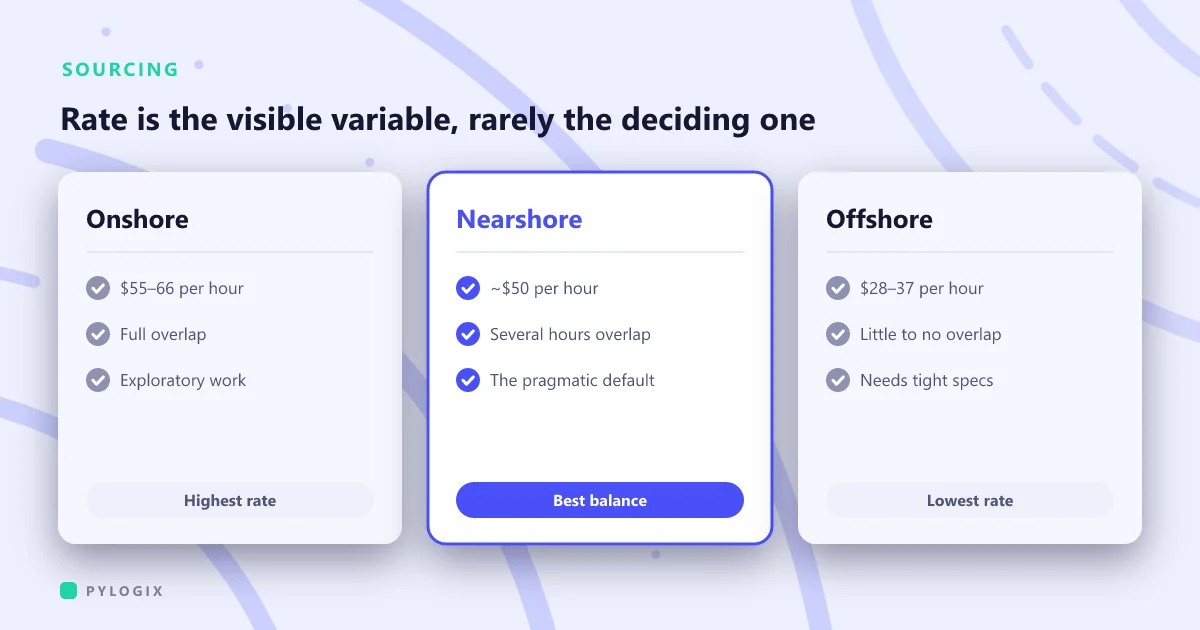

The sourcing decision gets made on a rate card more often than on anything else, which is understandable, because the rate card is the only part with numbers on it. The numbers are real. They are also the smallest part of the comparison.
What the rates actually look like
Published 2026 benchmarks put regional averages roughly as follows.
Two caveats before anyone plans around these. They are vendor-published, and vendors have an interest in the bands they quote. And the spread inside each region is wide enough that a senior engineer in Eastern Europe can cost more than a mid-level one in North America.
Where the rate saving goes
The saving is real and some of it is spent again in places that do not appear on an invoice.
Timezone overlap is the big one. With four hours of shared working time, a question asked in the morning is answered the same day. With one hour, or none, each exchange costs a day. A feature needing three clarifications takes three days longer, and that is before anyone has written code.
This compounds precisely where the work is least defined. On a well-specified task, low overlap is barely felt. On exploratory work where the team hits a question every few hours, it is the dominant cost, and it is the reason the same offshore team can look excellent on one project and hopeless on the next.
Specification burden shifts to you. A team you cannot casually ask needs more written down. That work is real, it lands on your side, and it is rarely counted when the saving is calculated.
Review and integration load. More code arriving from further away, in larger batches, means more review. If your bottleneck is already a senior engineer’s review time, adding cheaper capacity upstream makes the bottleneck worse rather than better.
The honest test is cost per delivered outcome over a quarter, not cost per hour. A team at $28 that needs twice as many hours and a day per clarification is not half the price of a team at $55. Sometimes it still wins. Often it does not, and the difference only shows up in the calendar.
What each model is actually good at
Onshore earns its premium where the work is exploratory, where regulation restricts who may touch data, or where the team must sit in workshops with your staff. If requirements are genuinely being discovered as you go, proximity is worth paying for.
Nearshore is the pragmatic middle: several hours of overlap, a moderate rate, and usually easier contracting than a distant jurisdiction. For most companies most of the time this is the best default, and Latin America for North America or Eastern Europe for Western Europe are the obvious pairings.
Offshore is strongest on well-specified, loosely coupled work: a defined module, a migration with known rules, sustained maintenance of a stable system, QA at volume. Give it clear boundaries and it is excellent value. Give it a half-formed idea and the rate advantage evaporates into round trips.
Questions that predict the outcome
- How many hours of overlap will we actually have? Not the offer of flexible hours. The hours in the contract.
- How specified is this work? If the answer is “we will figure it out together”, low overlap will hurt.
- Who reviews the output, and do they have capacity? Cheap upstream capacity does not help a blocked review queue.
- Where does the intellectual property sit legally? Ownership and enforceability vary by jurisdiction. Get it in writing before, not after.
- What happens to the code if this ends? Repository ownership, documentation and handover are contract terms, not courtesies.
The cost you cannot outsource
Whichever model you pick, the largest schedule cost usually sits on your side: how long it takes you to answer a question. If decisions take a week internally, no rate card rescues the project. Reducing the number of people who must approve things shortens delivery more reliably than moving the work between continents.
More on that in why software projects run over budget, on the employment comparison in in-house or outsourced, and on what to settle before signing in choosing a development partner.
We work from London and Houston, which gives usable overlap with both Europe and the Americas. If you are weighing sourcing options, tell us what the work looks like and we will say honestly where it should sit.
Common questions
How much cheaper is offshore software development?
Vendor-published 2026 benchmarks put Asia Pacific around $28 an hour and Western Europe around $66, so headline rates can differ by half or more. How much of that reaches your bottom line depends on timezone overlap, how well specified the work is, and how much review capacity you have.
Is nearshore better than offshore?
Usually for exploratory work, because several hours of shared working time keeps clarification cycles inside the same day. Offshore is strong on well-specified, loosely coupled work such as defined modules, migrations with known rules, and sustained maintenance.
What is the hidden cost of offshore development?
Clarification latency and specification burden. Every question that cannot be answered the same day adds a day, and a team you cannot casually ask needs more written down, which is work that lands on your side and rarely appears in the saving calculation.
Sources
- Regional average hourly rates for 2026 as published in vendor rate guides: Western Europe approximately $66, North America $55, Latin America $50, Eastern Europe $37, Africa $31, Asia Pacific $28. These are commercial sources rather than independent research, and ranges within each region are wide.
Written September 2026.