
Ask five firms what a piece of custom software costs and you get five numbers with no shared basis. Most published guidance is worse, because it quotes ranges without saying where they came from.
This article uses figures you can check. Everything below is sourced to the Bureau of Labor Statistics or to published research, dated, and listed at the end. Where a number cannot be sourced, it is not here.
What a developer earns in the US
Start with pay, because it is the one input with an authoritative public benchmark. The BLS Occupational Outlook Handbook puts the median annual wage for software developers at $135,980 as of May 2025, with wide spread either side.
What that developer actually costs you
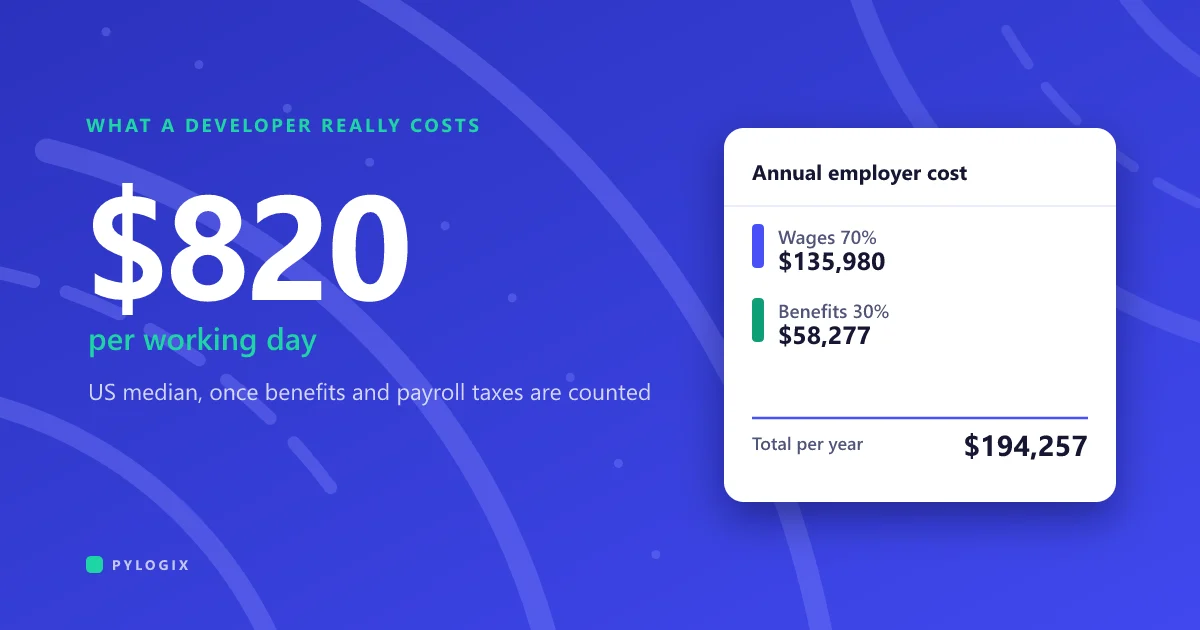
Salary is not cost. The BLS also tracks what employers pay in total, and the split is consistent: for private industry workers in June 2026, wages and salaries were 70.0% of employer compensation costs and benefits were the other 30.0%. Of that, paid leave ran 8.1% and legally required benefits (Social Security, Medicare, unemployment insurance, workers’ compensation) ran 7.0%.
Apply that ratio to the median developer wage.
Now convert that to a day. There are 260 weekdays in a year. Take off paid holidays and vacation, and a developer is available for roughly 237 of them.
| Line | Basis | Amount |
|---|---|---|
| Median wage | BLS, software developers, May 2025 | $135,980 |
| Benefits and payroll taxes | 30.0% of employer cost (BLS ECEC) | $58,277 |
| Annual employer cost | before any overhead | $194,257 |
| Days available | 260 weekdays less roughly 23 days holiday and vacation | 237 |
| Cost per working day | $194,257 ÷ 237 | $820 |
The figure most people carry in their head is $135,980 divided by 260, which is $523. The real number is about 57% higher, and it still excludes recruiting fees, laptops, software licences, desk space, training and the management time to run the person.
The 237 days is the one assumption here rather than a published figure, because the US has no statutory minimum leave. BLS reports that 81% of private industry workers have access to paid holidays and that 31% receive 10 to 14 vacation days after a year of service. Adjust it to your own policy and the per-day number moves accordingly.
This matters most when you compare an agency quote to “what it would cost us internally”. The comparison people make is against $523. The honest comparison is against $820, plus the recruiting lead time, plus the cost of carrying that person when a project pauses.
Why a day rate still does not give you a project price
Rates are the easy half. The hard half is how many days, and that is where published estimates stop being reliable.
The largest study on this remains McKinsey’s analysis with the University of Oxford of more than 5,400 IT projects.
Two things follow, and both are worth more than any range a supplier can quote you.
A contingency of ten percent is not a contingency. If the industry average overrun is 45%, then a plan with no room to move assumes you will beat the average comfortably, on your first attempt, with a supplier you have not worked with before.
The second point is less obvious and more useful. The value shortfall of 56% is larger than the cost overrun of 45%. Projects fail to pay for themselves more often than they fail to finish on budget. Budget is the thing everyone watches. It is not the thing that goes wrong most.
What actually moves your number
How many systems it has to talk to, and who controls them. A documented API with a sandbox is routine. A system with no test environment, no documentation and a vendor who charges for API access is a different project wearing the same description. Before anyone estimates, establish for each system whether an API exists, whether there is somewhere safe to test against it, and who internally can approve access.
What condition the data is in. Migration gets underestimated because people picture a copy operation. The work is in deciding what to do about duplicate records, fields used for something other than their label, and required values that are empty in a third of rows. Ask for real record counts before anyone quotes.
Whether the scope is decided or merely described. A build with agreed workflows and known edge cases can be estimated within roughly fifteen percent. One described as “like our current system but better” cannot be estimated yet, and no amount of quoting changes that. The undecided scope is the problem, not the estimate.
What compliance you are carrying. Payment data, health records under HIPAA, or personal data at volume all add access control, audit logging, retention rules, encryption and testing. Retrofitting that costs several times what including it costs, so it belongs in the first scope rather than a later phase.
Getting a number you can rely on
Given that overrun data, a single-stage fixed quote on a loose brief is a guess in a confident font. We price in two stages instead.
A short fixed-price discovery establishes scope, maps every integration, looks at the real data and settles the architecture. It ends with an estimate carrying a stated range and written assumptions, so when something moves you can see which assumption broke. Only then do we quote the build. If discovery shows the project should not go ahead as described, that is a cheap answer and a useful one.
Work then runs in two to three week releases, so cost and progress stay visible while there is still room to change direction. There is more on how we run builds on our custom software development page, and completed work in our case studies. Machine learning work prices differently enough that we treat it separately on the AI and machine learning page.
If you want a range for something specific rather than a general benchmark, tell us what you are trying to build. Bring whatever you have, even if it is only a description of the problem.
Common questions
Is it cheaper to hire a developer than to use an agency?
Not as often as the salary figure suggests. A median US developer costs an employer about $194,257 a year once benefits and payroll taxes are counted, which is roughly $820 per available working day before overhead. Employment wins when the work is continuous and open-ended. An agency usually wins when the project has a defined end, needs a skill for weeks rather than years, or cannot wait the two to four months a hire typically takes.
How much contingency should a software budget carry?
More than the ten percent most plans allow. Large IT projects run 45% over budget on average, so a realistic contingency sits in the fifteen to twenty percent range for a well-scoped build, and higher where integrations or data migration are involved.
Why do quotes for the same brief vary so widely?
Usually because the brief left the expensive questions open, so each supplier priced a different set of assumptions. A quote that lists its assumptions can be compared. One that does not is a number without a basis, and the gap gets settled later through change requests.
Sources
- US Bureau of Labor Statistics, Occupational Outlook Handbook: Software Developers, Quality Assurance Analysts, and Testers. Median annual wage $135,980 in May 2025. Lowest 10% under $82,460, highest 10% over $214,670.
- US Bureau of Labor Statistics, Employer Costs for Employee Compensation, June 2026. Private industry: wages and salaries $32.82 per hour worked (70.0% of employer costs), benefits $14.07 (30.0%). Paid leave 8.1%, legally required benefits 7.0%.
- US Bureau of Labor Statistics, Employee Benefits in the United States, March 2025, for paid holiday and vacation incidence.
- McKinsey & Company with the University of Oxford, Delivering large-scale IT projects on time, on budget, and on value. More than 5,400 projects: 45% average cost overrun, 7% schedule overrun, 56% less value than predicted, 17% company-threatening.
- For UK readers, IT Jobs Watch put the median advertised Software Developer contract rate at £525 per day in the six months to 21 September 2026.
Figures were current at the time of writing (September 2026). Wage and rate data moves, so check the source before relying on it.