
Both platforms run a large share of the web’s online stores. W3Techs counts WooCommerce on 7.8% of all websites and Shopify on 5.3%, as of November 2026. Both are good. Choosing between them by feature list rarely works, because each can be made to do almost anything with enough apps or plugins.
The decision is better made on two things: what the store will actually cost to run at your volume, and who will look after it.
What each one charges, from the published prices
| Shopify plan | Monthly billing | Yearly billing, per month | Online card rate, US | Fee if you use another processor |
|---|---|---|---|---|
| Basic | $39 | $29 | 2.9% + 30¢ | 2% |
| Grow | $105 | $79 | 2.7% + 30¢ | 1% |
| Advanced | $399 | $299 | 2.5% + 30¢ | 0.6% |
| Plus | from $2,300 | 2.25% + 30¢ | 0.2% | |
WooCommerce itself is free. A typical setup pays for three things instead:
- Payments. WooPayments charges 2.9% + 30¢ for US cards, plus 1.5% for international cards and 1% where currency conversion applies, with no monthly fee. Other processors price similarly.
- Extensions. Many essential features are paid extensions renewed annually. WooCommerce Subscriptions, for example, is $279 a year, which covers updates and support. A real store usually runs several.
- Hosting and upkeep. You choose and pay for hosting, and someone has to apply updates to WordPress, WooCommerce and every plugin, test that checkout still works, and respond when something is compromised.
A worked example at $40,000 a month
A store selling $40,000 a month across 800 orders, an average order of $50, all paid by US cards online. Monthly billing on Shopify.
| Setup | Card fees | Plan or platform fee | Monthly total |
|---|---|---|---|
| Shopify Basic | 2.9% + 30¢ = $1,400 | $39 | $1,439 |
| Shopify Grow | 2.7% + 30¢ = $1,320 | $105 | $1,425 |
| Shopify Advanced | 2.5% + 30¢ = $1,240 | $399 | $1,639 |
| Shopify Grow, outside processor at 2.9% + 30¢ | $1,400 to the processor | $105 + 1% = $505 | $1,905 |
| WooCommerce with WooPayments | 2.9% + 30¢ = $1,400 | hosting and extensions, varies | $1,400 + upkeep |
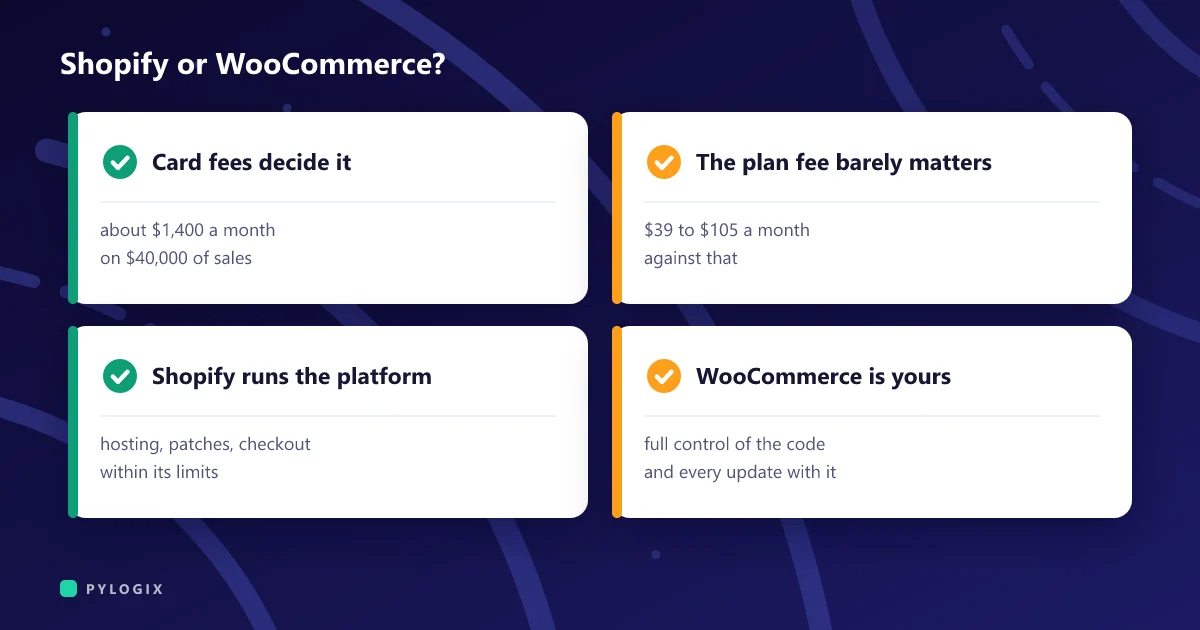
Three things come out of this. Payment processing is most of the bill on every plan, over 90% on Basic and Grow. The mid-tier plan is the cheapest at this volume, because the lower card rate more than covers the higher subscription. And using an outside processor on Shopify is the expensive choice unless the processor’s own rate is much lower, because Shopify’s extra percentage applies on top.
When the next Shopify plan pays for itself
Each step up lowers the card rate by 0.2 percentage points. Divide the extra subscription by 0.2% and you have the monthly sales at which the step breaks even:
| Step | Extra per month | Break-even monthly sales |
|---|---|---|
| Basic to Grow, monthly billing | $66 | $33,000 |
| Basic to Grow, yearly billing | $50 | $25,000 |
| Grow to Advanced, monthly billing | $294 | $147,000 |
| Grow to Advanced, yearly billing | $220 | $110,000 |
These cover card fees only. Advanced and Plus also add staff accounts, reporting and other features you may want earlier for their own sake. Plus is a different decision again, covered in Shopify Plus or headless commerce.
The costs that do not appear on a pricing page
Apps and extensions
On Shopify, most stores add apps for reviews, subscriptions, search, bundles, loyalty and more, each with its own monthly charge on the Shopify bill. On WooCommerce, the equivalent extensions renew yearly. Either way, the add-ons often cost more than the plan.
List the features you need and price the apps or extensions for each before comparing platforms. That list is the real comparison.
Maintenance and security
Shopify runs the platform, the hosting, security patches and PCI compliance for checkout. On WooCommerce those are yours. A WooCommerce store with twenty plugins has twenty things that need updating, any of which can break checkout or open a hole if left alone.
Put a named person and a monthly budget against WooCommerce upkeep, or budget for the incident instead. The general case is in what software maintenance really costs after launch.
The custom logic you will eventually want
Wholesale pricing by customer, unusual shipping rules, complex bundles, integration with an ERP or warehouse system. WooCommerce lets you change almost anything, because you own the code. Shopify deliberately limits what you can change, particularly in checkout, in exchange for stability.
Write down the business rules that are unusual about how you sell, and check each against the platform before you choose it.
Which one, honestly
Choose Shopify when
- You want to sell, not run software
- Nobody on your side will own updates and security
- Your selling rules are fairly standard
- You expect to grow and want the platform to scale for you
Choose WooCommerce when
- Content and commerce are closely mixed on one WordPress site
- You need custom logic Shopify will not allow
- You have a developer, in-house or retained, who owns the site
- You want to own the code, the data and the hosting outright
The most expensive outcome is a WooCommerce store chosen because it was free, with nobody responsible for it. Three years later it has thirty plugins nobody dares update, and the store moves platforms under pressure rather than by choice. We covered what that migration involves in replatforming from Magento or WooCommerce.
Before you decide
- Work out your card fees at next year’s expected sales, not this month’s, on each plan. Use the tables above.
- Price the add-ons for every feature you need on both platforms.
- Name who will maintain the store and what that costs per month.
- List your unusual selling rules and test each against the platform, ideally in a trial store.
- Check the integrations you need with accounting, inventory, ERP and marketing tools on each side.
We build and migrate stores on both platforms, connect them to the rest of the business through custom software and integrations, including Shopify Plus builds for fashion and lifestyle brands, which you can see in our case studies. More on how we work is on our ecommerce development page. If you are choosing or thinking of switching, tell us your monthly volume and how you sell and we will tell you which platform costs less for you.
Common questions
Is Shopify or WooCommerce cheaper?
It depends on volume and on who maintains the store. On a store selling $40,000 a month by US card, card fees are about $1,240 to $1,400 a month on either platform, and the Shopify plan adds $39 to $105. WooCommerce has no plan fee but needs hosting, paid extensions renewed annually, and someone to keep it updated and secure, which usually outweighs the plan fee it saves.
What are Shopify’s transaction fees?
With Shopify Payments, US online card rates are 2.9% plus 30 cents on Basic, 2.7% plus 30 cents on Grow, 2.5% plus 30 cents on Advanced and 2.25% plus 30 cents on Plus. If you use a different payment provider, Shopify adds a fee of 2%, 1%, 0.6% or 0.2% respectively, on top of what that provider charges.
When should I upgrade from Shopify Basic to Grow?
On card fees alone, Grow pays for itself at about $33,000 a month in online card sales on monthly billing, or about $25,000 on yearly billing. Grow’s card rate is 0.2 percentage points lower, which covers its higher subscription at that volume. Grow to Advanced breaks even at about $147,000 a month on monthly billing.
Is WooCommerce free?
The software is free to install. Running a store is not: you pay for hosting, payment processing at about 2.9% plus 30 cents for US cards through WooPayments, and paid extensions such as WooCommerce Subscriptions at $279 a year. You also take on updates, security and checkout testing, which Shopify handles on its own platform.
Sources
- Shopify, pricing page, retrieved November 2026: Basic $39 a month or $29 billed yearly, Grow $105 or $79, Advanced $399 or $299, Plus from $2,300 a month. Standard US online card rates 2.9%, 2.7%, 2.5% and 2.25%, each plus 30 cents. Third-party payment provider transaction fees 2%, 1%, 0.6% and 0.2%.
- Shopify Help Center, app charges on the Shopify bill: third-party app subscriptions are billed on the regular Shopify invoice on each app’s own 30-day cycle.
- WooCommerce, WooPayments fees documentation, retrieved November 2026: US-issued cards 2.90% + $0.30, international payments +1.50%, currency conversion +1.00%; no setup costs or monthly fees.
- WooCommerce Marketplace, WooCommerce Subscriptions, retrieved November 2026: $279 for a one-year subscription, covering product updates and customer support.
- W3Techs, usage statistics, November 2026: WooCommerce used by 7.8% of all websites, Shopify by 5.3%.
- The worked example and break-even figures are our arithmetic from the published rates above. They assume all sales are online US card payments and exclude refunds, chargebacks, taxes and in-person sales.
Written November 2026. Platform pricing changes. Check the current rates for your country before deciding.