
“How much does an app cost?” gets answered with ranges so wide they are useless: $10,000 to $500,000, depending. The range is wide because the question is. A loyalty app that shows a points balance and a field service app that works offline in a basement are both “an app”, and they differ in effort by a factor of ten.
So instead of another range, here is how the number is actually built, what each part costs, and the costs that arrive after launch that most first budgets leave out.
The unit is a person-day, and here is what one costs
Every honest estimate is effort multiplied by a rate. We worked the rate out in detail in what custom software actually costs, from Bureau of Labor Statistics data:
| Line | Basis | Amount |
|---|---|---|
| Median wage, software developers | BLS, May 2025 | $135,980 |
| Benefits and payroll taxes | 30.0% of employer cost (BLS ECEC) | $58,277 |
| Annual employer cost | before any overhead | $194,257 |
| Cost per available working day | $194,257 ÷ 237 days | $820 |
That is the in-house cost of a median developer, with no office, no management and no margin. An agency or contractor rate will sit above it, onshore or not, as we covered in onshore, nearshore, offshore. It is still the right yardstick: it tells you what the effort would cost you to staff yourself, which is the alternative any quote is competing with.
Three kinds of app, three orders of magnitude of effort
These effort ranges are our own estimates from scoping mobile work, not survey data. Nobody publishes credible survey figures for app build effort, and the numbers that circulate online are mostly agencies quoting themselves. We give them because a reasoned range with its assumptions written down is more useful than none.
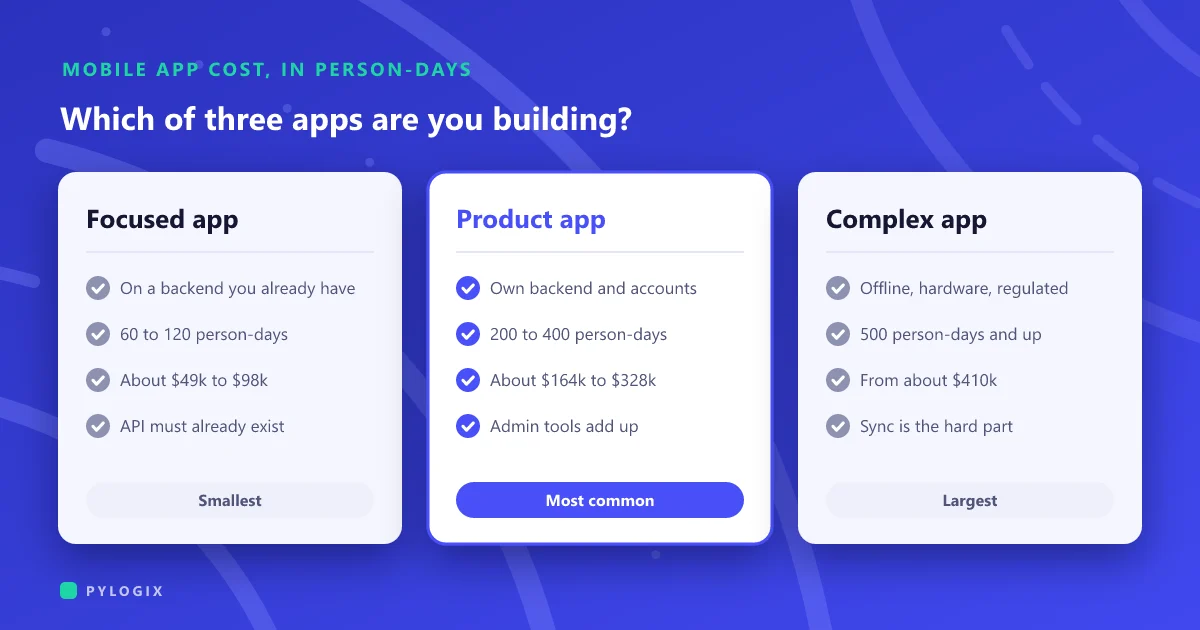
A focused app on a backend you already have: 60 to 120 person-days
A companion to a system that already exists: customers check an order, an account balance, a booking. The data and the rules live somewhere else, and the app reads and writes through an API that is already there and already documented.
At $820 a day that is roughly $49,000 to $98,000. The low end assumes the API is genuinely ready. If it has to be built or fixed first, you are in the next category whether you meant to be or not.
A product with its own backend, accounts and payments: 200 to 400 person-days
Most startup and new-product apps. Sign-up and login, profiles, a database, payments or subscriptions, push notifications, and an admin panel for your own staff. The app is the visible part of a system you are building from scratch.
Roughly $164,000 to $328,000. The spread is mostly the admin side and the integrations, which are the parts nobody draws in the first wireframes.
Offline sync, hardware or regulated data: 500 person-days and up
Field service apps that must work without signal and reconcile later. Apps that talk to Bluetooth devices, scanners or cameras as a core function. Anything holding health or financial data with audit requirements.
Roughly $410,000 to $738,000, and the top is not a ceiling. Offline sync alone is a distributed systems problem: two people edit the same record without a connection, and the app has to decide what is true when they reconnect.
Where the effort actually goes
When people picture an app, they picture the screens. The screens are usually a minority of the work.
- The backend. Data model, business rules, the API, authentication, background jobs. In a category 2 app this is often the largest single block.
- The admin tools. Somebody on your side has to refund a payment, ban a user, edit content and answer a support ticket. Every one of those is a screen in a web app nobody budgeted for.
- Device and OS testing. Real phones, several screen sizes, older OS versions, poor networks, permissions denied. This is what separates an app that demos well from one with good reviews.
- Store submission. Privacy declarations, review guidelines, screenshots, and the occasional rejection that costs a week.
- Integration. Payments, analytics, crash reporting, CRM, push. Each is small and each comes with its own failure modes, which we covered in why connecting two systems costs more than building one.
Cross-platform frameworks such as Flutter and React Native share the screens and the business logic between iOS and Android. They do not share the backend, the admin tools, store submission or most of the device testing, which is why one codebase does not halve the cost. The full comparison is in Flutter or native.
The costs that start after launch
The build is a one-off. These are not.
The stores force an update cycle
Apple and Google both set a minimum toolchain for anything you upload, and they raise it every year. Since 28 April 2026, apps uploaded to App Store Connect must be built with Xcode 26 and the iOS 26 SDK. On Google Play, from 31 August 2026, new apps and updates must target Android 16, API level 36, and existing apps must target at least API level 35 to stay visible to new users on newer devices.
In practice that means you cannot ship even a one-line bug fix from an old project without first bringing it up to date. An app that was finished and left alone for eighteen months usually needs days of upgrade work before its next release. Budget for at least one deliberate update a year, whether or not you add features.
Accounts and store fees
| Item | Cost |
|---|---|
| Apple Developer Program | $99 a year |
| Google Play developer registration | $25, once |
| Apple commission on digital sales, Small Business Program | 15% for developers earning up to $1 million a year |
| Google Play service fee | 15% on the first $1 million of earnings a year, once enrolled in that tier |
Commission applies to digital goods and subscriptions sold inside the app. Physical goods and services, an order of shoes or a booked appointment, go through your own payment processor instead. Store fee rules have changed several times since 2024 and differ by country, so check the current terms for your market before you build a business model on them.
Maintenance
Servers, monitoring, the annual OS cycle, dependency updates, security patches and the steady trickle of fixes. We set out the arithmetic in what software maintenance really costs after launch. For an app, the OS cycle makes this less optional than it is for a web system.
How to bring the number down
The rate is the lever people reach for and the one that moves least. The effort is where the money is.
- Cut scope before the build, deliberately. Every feature you can launch without saves its build, its testing and its maintenance. Deciding what to build first covers how to do that without shipping something nobody wants.
- Reuse a backend you already have. If the system of record exists, the app is a client of it. That can move a project from category 2 to category 1.
- Ask whether it needs to be an app at all. If users visit once a month and need no camera, offline mode or push, a responsive web app avoids store review, store fees and the annual SDK cycle entirely.
- Launch on one platform if your users allow it. If your customers are overwhelmingly on one platform, starting there halves device testing and submission work while you find out whether the product works.
- Write the brief properly. Vague requirements get padded quotes, because the supplier is pricing the uncertainty. A brief that gets accurate quotes is the cheapest document you will ever commission.
We build iOS and Android apps, usually in Flutter, along with the backend and admin tools behind them. If you want an estimate with the assumptions written down rather than a single number, tell us what the app needs to do and we will tell you which of the three categories it is really in. More on how we work is on our mobile app development page.
Common questions
How much does it cost to build a mobile app in 2026?
It depends on what the app is, more than on who builds it. At the in-house cost of a median US developer, about $820 per working day, a focused app on an existing backend is roughly $49,000 to $98,000, a product with its own backend, accounts and payments is roughly $164,000 to $328,000, and apps with offline sync, hardware integration or regulated data start around $410,000. These are effort estimates multiplied by a published wage figure, not survey data.
Why does the backend cost more than the app?
Because it holds everything that has to be right: the data, the business rules, authentication, payments, background jobs and the admin tools your staff use. The screens display the result. In a typical product app, the server side and the admin panel together take more effort than the iOS and Android interface.
Do I have to keep updating an app after launch?
Yes. Apple and Google raise their minimum build requirements every year. Apple has required the iOS 26 SDK for uploads since 28 April 2026, and Google Play requires new apps and updates to target API level 36 from 31 August 2026. An app left untouched cannot ship even a small fix without upgrade work first, so plan at least one deliberate update a year.
Is Flutter cheaper than building two native apps?
Usually, but by less than half. Flutter shares the interface and business logic across iOS and Android. The backend, admin tools, store submission and most device testing are not shared, and platform-specific features still need native code. The saving is real on the app side and close to zero on everything around it.
Sources
- US Bureau of Labor Statistics, Occupational Employment and Wage Statistics, May 2025: software developers, median annual wage $135,980.
- US Bureau of Labor Statistics, Employer Costs for Employee Compensation, June 2026: wages and salaries 70.0% of private industry employer costs, benefits 30.0%.
- Apple, Upcoming requirements, Apple Developer, retrieved November 2026: since 28 April 2026 apps uploaded to App Store Connect must be built with Xcode 26 or later using an SDK for iOS 26, iPadOS 26, tvOS 26, visionOS 26 or watchOS 26.
- Google, Target API level requirements for Google Play apps, Android Developers, retrieved November 2026: from 31 August 2026 new apps and updates must target Android 16 (API level 36); existing apps must target API level 35 or higher to remain available to new users on newer devices.
- Apple Developer Program, membership page, retrieved November 2026: $99 annual membership. Apple App Store Small Business Program: 15% commission for developers earning up to $1 million in proceeds a year.
- Google Play Console Help, Service fees, retrieved November 2026: $25 one-time registration fee; 15% service fee on the first $1 million of earnings each year for developers enrolled in that tier.
- The effort ranges in person-days are Pylogix estimates from scoping mobile projects. We have not quoted third-party app cost surveys, because the widely repeated figures are agency self-reporting rather than measured data.
Written November 2026. Store requirements and fees change every year. Check the current terms before relying on them.