
Most comparisons of this kind are written for developers and argue about rendering pipelines. If you are paying for the app rather than writing it, almost none of that changes your decision. Three things do: what you can afford to maintain, who you can hire, and whether your product needs anything the shared layer cannot reach.
The cost that matters is the second year
Build cost gets all the attention and is the smaller number. The structural cost of going native on both platforms is that every subsequent change happens twice: specced once, built twice, reviewed twice, tested twice, submitted twice, and fixed twice when it breaks. Forever.
That is the actual argument for cross-platform, and it is a good one. But it is routinely oversold as a halving of cost, which it is not, because a meaningful part of mobile work was never in the shared layer.
Adoption and hireability point in opposite directions
This is the most decision-relevant fact in the whole comparison and it rarely leads.
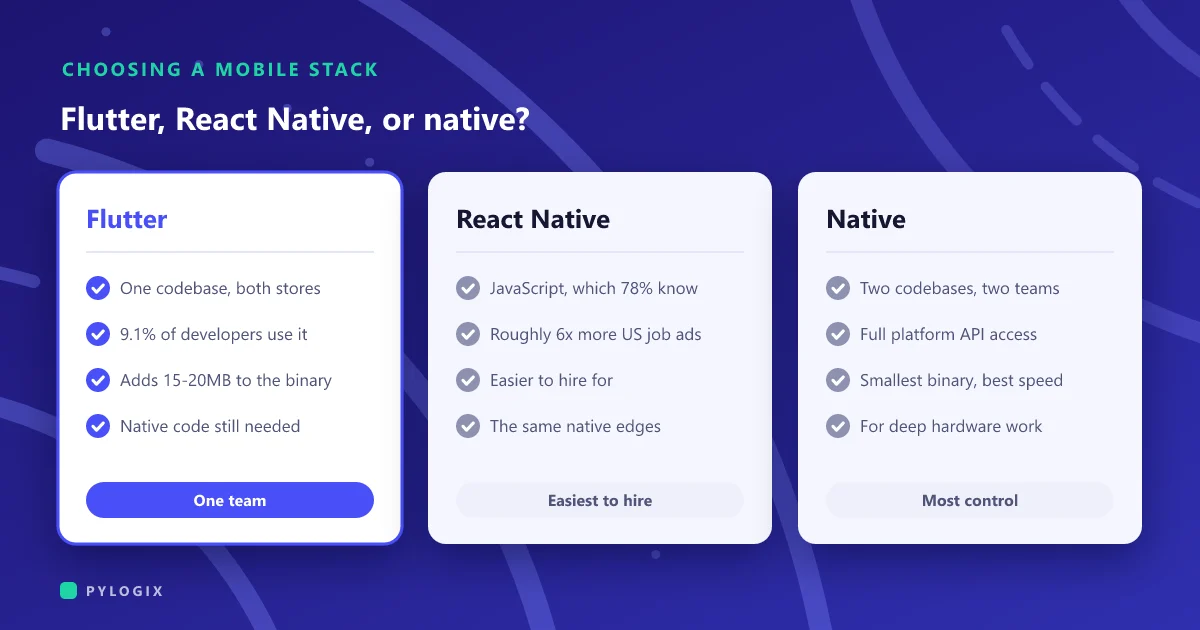
Flutter is used by 9.12% of developers against React Native’s 8.43% in Stack Overflow’s 2025 survey, and leads on GitHub interest. React Native is built on JavaScript, which 78% of working developers already know, which is why the job market looks so different.
Translate that into your situation directly. A company with an existing React web team can staff React Native from people it already employs. A company hiring from scratch in a smaller US market will find React Native candidates faster. A company that wants one small, highly consistent app team, and can wait to hire the right person, does fine with Flutter.
You will still write native code
Every cross-platform framework has a boundary, and past it you are writing Swift and Kotlin whether you planned to or not.
- Deep OS integration. Widgets, share extensions, Siri and Assistant integration, system-level shortcuts.
- Sustained background processing. Location tracking, audio, sync that must keep running. Both platforms police this aggressively and differently.
- Advanced camera and Bluetooth. Custom capture pipelines, frame processing, non-standard peripherals.
- Platform-specific interface behaviour. Where a control genuinely has to feel like the platform rather than like your design system.
- Certain vendor SDKs. Payments, health data and hardware vendors often ship native-first, with community wrappers that lag.
None of these rules out cross-platform. They do mean the plan should name who writes that code, because a team hired entirely on Dart or JavaScript skills will stall at the first one.
Two smaller facts that occasionally decide it
App size. Flutter ships its own rendering engine, which typically adds somewhere around 15 to 20 MB over an equivalent native binary. For most products this is irrelevant. It stops being irrelevant if you sell into markets with expensive mobile data, or if install conversion is a metric you actually track.
Performance. Fine for the overwhelming majority of apps, including anything that is mostly lists, forms and network calls. It matters for heavy graphics, real-time signal or video processing, and long-running background computation. If your app is one of those, you probably already know.
Choosing, in practice
Choose Flutter
- You want one small team owning both platforms
- The interface is the product and should look identical everywhere
- You can afford to hire deliberately rather than quickly
- Binary size is not a business metric for you
Choose React Native
- You already have React developers
- Hiring speed matters more than anything else on this page
- You want web and mobile sharing people, if not code
- You are comfortable in the JavaScript ecosystem’s pace
Choose native
- Hardware, sensors or background work are the product
- You ship one platform only, which halves the argument
- You already employ both native teams
- Compliance or platform certification demands it
A fourth answer that gets forgotten: for a lot of internal tools and content-led products, the right mobile strategy is a good responsive web application and no app at all. No store review, no release cycle, no install friction, one codebase in the genuine sense. Worth ruling out explicitly before committing to any of the three columns above, and the reasoning is the same as in deciding what to build first.
Five questions that settle it
- Which platforms must you ship, and when? One platform removes most of the cross-platform advantage immediately.
- Does the app need anything on the native-work list above? If yes, name who writes it.
- Who maintains this in year two, and can you hire them where you are? Check actual listings in your market rather than global survey figures.
- Is the interface meant to feel like your brand, or like the platform? Flutter favours the first, native the second, React Native sits between.
- What is your release cadence? Shipping weekly across two native codebases is a real operational commitment that shows up as headcount.
Answer those and the technology choice usually falls out without an argument. Answer none of them and you will pick based on whoever spoke most confidently in the meeting, which is how most of these decisions actually get made.
Related: how long a custom application takes covers the timeline side, maintenance costs after launch covers the year-two figure this post keeps pointing at, and in-house or outsourced covers who does the work.
We build in Flutter and natively, and the honest answer sometimes is that you need a web app instead. If you want an outside read before committing a codebase, tell us what the app has to do.
Common questions
Is Flutter cheaper than native app development?
Usually, but not by half. One codebase removes duplication from business logic and most of the interface. It does not remove platform integration work, testing on real devices from both ecosystems, two store submissions, or adapting the design to each platform’s conventions. The saving is real and compounds over years of maintenance, because every post-launch change otherwise happens twice.
Should I choose Flutter or React Native?
Adoption is close: 9.12% of developers reported using Flutter against 8.43% for React Native in Stack Overflow’s 2025 survey. Hiring is not close, with roughly six times more US job listings for React Native, largely because it is built on JavaScript, which 78% of working developers already know. Choose React Native if you have React developers or need to hire quickly. Choose Flutter if you want one small team with a highly consistent interface and can hire deliberately.
When should you build a native app instead of cross-platform?
When hardware is the product: custom camera pipelines, non-standard Bluetooth peripherals, sustained background processing or deep OS integration. When you ship only one platform, which removes most of the cross-platform advantage. When you already employ both native teams. And when platform certification or compliance requirements make the extra abstraction layer a liability.
Do Flutter apps have a larger file size?
Yes. Flutter ships its own rendering engine, which typically adds around 15 to 20 MB over an equivalent native binary. For most products this is irrelevant. It matters if you sell into markets where mobile data is expensive, or if install conversion is a metric you actively manage.
Sources
- Stack Overflow Developer Survey 2025: 9.12% of respondents reported using Flutter and 8.43% React Native. JavaScript was reported as used by 78% of working developers. The 2024 survey showed a similar gap at 9.4% and 8.4%.
- US job listing volume for React Native is reported at roughly six times that for Flutter across job-board analyses. This is an aggregated figure from recruitment data rather than a single authoritative source, and it varies by city and seniority. Check listings in your own market before relying on it.
- Flutter’s larger binary size, commonly cited at 15 to 20 MB above an equivalent native app, is a consequence of bundling the Flutter engine with the application.
- Claims about market share percentages for cross-platform frameworks circulate widely with inconsistent methodology and are not used here. The developer-usage figures above come directly from the Stack Overflow survey. The job-listing ratio is labelled as an aggregate.
Written September 2026.