
Accessibility usually enters a project as a line in a requirements document that says the site will be accessible, and leaves it as a remediation invoice eighteen months later. The gap between those two events is where all the cost is.
It is also now a scheduling problem rather than a principle, because several US deadlines have arrived and one of them is behind us.
The dates, as they currently stand
| Who | Standard | Deadline |
|---|---|---|
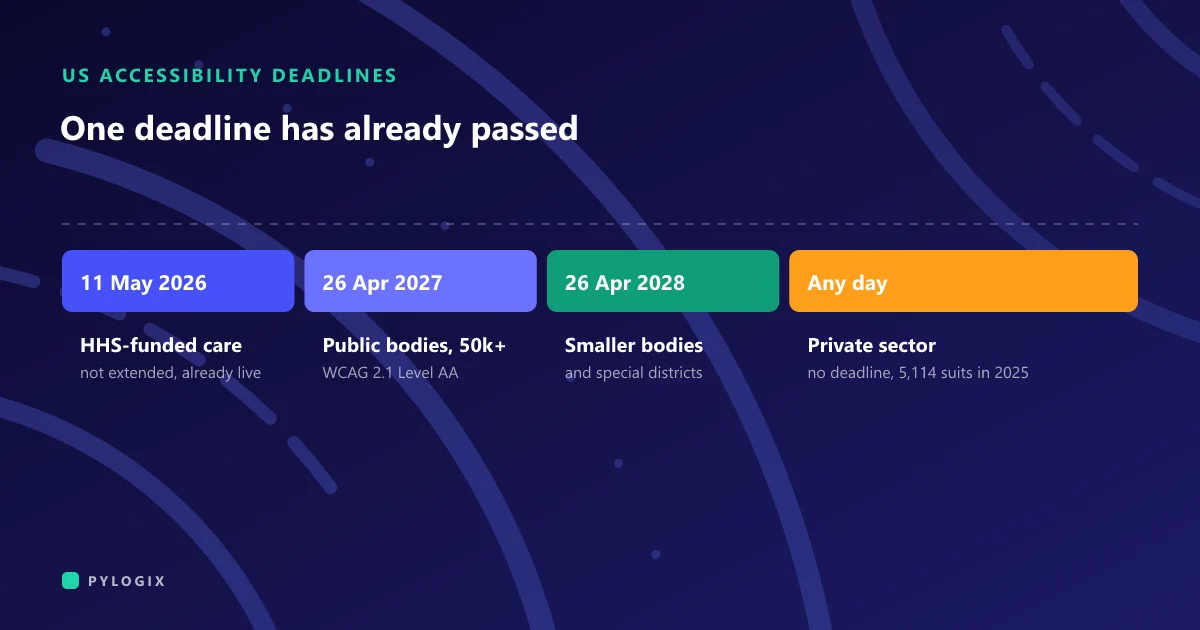
| Healthcare receiving HHS funding | WCAG 2.1 Level AA | 11 May 2026, passed |
| State and local government, 50,000+ population | WCAG 2.1 Level AA | 26 April 2027 |
| Smaller public entities and special districts | WCAG 2.1 Level AA | 26 April 2028 |
| Federal agencies and their suppliers | Section 508 | already in force |
| Private sector | no rule specifies one | no deadline, continuous litigation |
The DOJ published its Title II final rule on 24 April 2024, adopting WCAG 2.1 Level AA as the technical standard for web content and mobile applications. On 20 April 2026 it issued an interim final rule extending the compliance dates by one year. The requirement did not change and the standard did not change. Only the date moved.
The extension applies to DOJ’s Title II rule. It does not apply to the HHS Section 504 requirement for recipients of HHS funding, whose 11 May 2026 date has passed and was not extended. If you build or run systems for healthcare organisations taking federal funding, that obligation is live now rather than upcoming, and the common assumption that “the deadline moved” is about a different rule.
The private sector has the bigger problem
No US regulation sets a web accessibility standard or a deadline for ordinary commercial websites. That sounds like good news and is the opposite, because the obligation gets defined in court instead, continuously, by whoever files.
That 45% figure is the practical argument for doing this structurally. A company that receives a complaint, pays for a remediation pass on the pages named in it, and moves on remains in the same population next year, because the next release reintroduces the same defects from the same components.
On overlays, plainly
Accessibility overlays are scripts that promise to make a site conformant by adding a widget. They do not establish conformance with WCAG, they cannot fix the structural problems that generate most complaints, and sites running them appear in the litigation data regularly. Some of the filings specifically concern the overlay.
If someone is selling you a line of JavaScript as a compliance solution, the thing being sold is the feeling of having addressed it. We would rather say that directly than let it be discovered during discovery.
Why this is architecture, not decoration
The same argument as security requirements: some of it can be added any time, and some of it is baked into how the system is built.
Cheap to fix later
- Colour contrast in a token file
- Missing alt text on content images
- Page titles and language attributes
- Link text that says “click here”
Expensive, because it is structural
- Semantic markup and heading order across every component
- Keyboard operability of custom controls
- Focus management when views change without a page load
- Form errors announced to assistive technology
Only fixable at the source
- A component library built on non-semantic markup
- A design system with no focus styles defined
- A pattern where every dialog traps or loses focus
- Media produced with no captions, ever
The third column is why page-by-page remediation is bad economics. One accessible dropdown component fixes every dropdown in the product permanently. Forty remediated pages fix forty pages until the next release.
What to put in the brief
Name the conformance target
“WCAG 2.1 Level AA” rather than “accessible”. It is the standard the US rules adopt, it is testable, and it gives a supplier something to price and be held to.
Say which surfaces it covers: the marketing site, the authenticated application, the mobile apps, PDFs and any embedded third-party content. The last two are where the arguments happen.
Make it a component-level acceptance criterion
Not a project-level promise. Each component in the library is accepted only when it is keyboard operable, announces its state, manages focus correctly and meets contrast.
Put it in the definition of done, so it is priced into every component rather than discovered as a separate remediation line at the end.
Specify how it will be tested
Automated tooling in the pipeline catches a minority of issues and is still worth having, because it catches regressions for free. It cannot judge whether alt text is meaningful, whether focus order makes sense, or whether an error message is comprehensible.
Require keyboard-only and screen-reader testing of key journeys, named specifically, and say who performs it. “We run an automated scan” is not a test plan.
Cover the content, not just the code
A perfectly built site fails on uncaptioned video, scanned PDFs and images of text uploaded by a content team with no guidance. Most live complaints are about content rather than components.
Decide who is responsible for captions, transcripts and alt text as an ongoing job, and build the prompts for it into the CMS rather than the style guide.
If you have an existing product
- Audit against WCAG 2.1 AA with a named methodology, not a scan. The output is a list of findings mapped to components, not to pages.
- Group by component. Forty page-level findings usually collapse into six component defects, which is a much smaller and more durable piece of work.
- Fix the component library first, highest-traffic patterns first. The improvement propagates.
- Add automated checks to the pipeline immediately, even though they catch a minority. Their job is stopping regression, not finding everything.
- Test the top journeys with a keyboard and a screen reader, repeatedly. Sign-up, search, checkout, account, support.
- Write it down. An accessibility statement describing the target, what conforms, what does not and when it will, is expected under the public-sector rules and is useful evidence of good faith everywhere else.
One thing that is genuinely true and gets said badly: this work makes the product better for everyone. Keyboard operability helps power users. Clear focus states help anyone on a laptop trackpad. Captions get watched in offices and on trains. Proper form errors reduce support tickets. We mention it not as a moral argument but because it changes how you justify the budget, and the budget is usually the blocker.
Related: security and compliance to specify before development starts is the same discipline for a different regime, writing a brief that gets accurate quotes covers where these requirements live, and what maintenance really costs covers keeping it fixed.
We build accessibility into the component library and the definition of done, because the alternative is a remediation project that does not stay remediated. If you have a deadline, a complaint, or a product you have never tested with a keyboard, tell us what you are running.
Common questions
What is the deadline for ADA website accessibility compliance?
It depends who you are. Healthcare organisations receiving HHS funding were required to comply by 11 May 2026, and that date was not extended. State and local governments serving 50,000 or more people have until 26 April 2027, and smaller entities and special district governments until 26 April 2028, following a one-year extension the DOJ issued in April 2026. The private sector has no deadline set by any rule, which is why the obligation is defined through litigation instead.
What accessibility standard do US rules require?
WCAG 2.1 Level AA. The DOJ adopted it in its April 2024 Title II final rule as the technical standard for web content and mobile applications, and the one-year extension issued in 2026 moved the dates without changing the standard. Federal agencies and their suppliers are covered separately by Section 508.
Do accessibility overlays make a website compliant?
No. Overlay widgets do not establish conformance with WCAG, cannot fix the structural problems that generate most complaints, such as non-semantic components, broken focus management and inaccessible custom controls, and sites using them appear in accessibility litigation regularly, sometimes over the overlay itself. They are a purchase of reassurance rather than conformance.
How many ADA website lawsuits are filed each year?
5,114 digital accessibility lawsuits were filed across US federal and state courts in 2025. Federal website accessibility filings alone rose from 2,452 in 2024 to 3,117 in 2025, an increase of 27%. Around 70% targeted ecommerce. The figure most worth noting is that 45% of federal filings were against companies that had already been sued, which is what a one-off page-level remediation buys you.
Sources
- US Department of Justice final rule on nondiscrimination on the basis of disability, accessibility of web information and services of state and local government entities, published 24 April 2024, adopting WCAG 2.1 Level AA. Interim final rule of 20 April 2026, 91 Fed. Reg. 20902, extending compliance dates by one year to 26 April 2027 for public entities serving 50,000 or more and 26 April 2028 for smaller entities and special district governments. The technical standard was unchanged.
- US Department of Health and Human Services Section 504 rule, compliance date 11 May 2026 for recipients of HHS funding. Not extended alongside the DOJ dates.
- Litigation counts: 5,114 US digital accessibility lawsuits filed across federal and state courts in 2025, with approximately 70% targeting ecommerce and 45% of federal filings against companies previously sued. A mid-year 2026 projection of roughly 6,176. Separately, 3,117 federal website accessibility lawsuits were recorded in 2025 against 2,452 in 2024, an increase of 27%. Counts vary between trackers depending on which courts and case types are included, so treat them as an order of magnitude and a trend.
- This article is general commercial guidance, not legal advice. Whether a particular rule applies to your organisation is a question for a qualified lawyer.
Written September 2026. Compliance dates have already moved once. Verify against the current rule before acting.