
The in-house versus outsourced decision usually gets settled with a cost comparison, and the comparison is usually wrong. A salary gets divided by the number of weekdays in a year, an agency rate gets set beside it, outsourcing looks expensive, and the decision is made on a number that leaves out most of what each option costs.
Here is the same comparison using figures you can check.
What an employee actually costs
The Bureau of Labor Statistics puts the median US software developer wage at $135,980 as of May 2025. That is the number most people work from. It is not the cost.
The BLS also tracks total employer outlay. For private industry workers in June 2026, wages were 70.0% of employer compensation costs and benefits were the other 30.0%, covering paid leave, insurance and legally required contributions like Social Security and Medicare.
| Line | Basis | Amount |
|---|---|---|
| Median wage | BLS, software developers, May 2025 | $135,980 |
| Benefits and payroll taxes | 30.0% of employer cost (BLS ECEC) | $58,277 |
| Annual employer cost | before overhead | $194,257 |
| Days available | 260 weekdays less roughly 23 days leave | 237 |
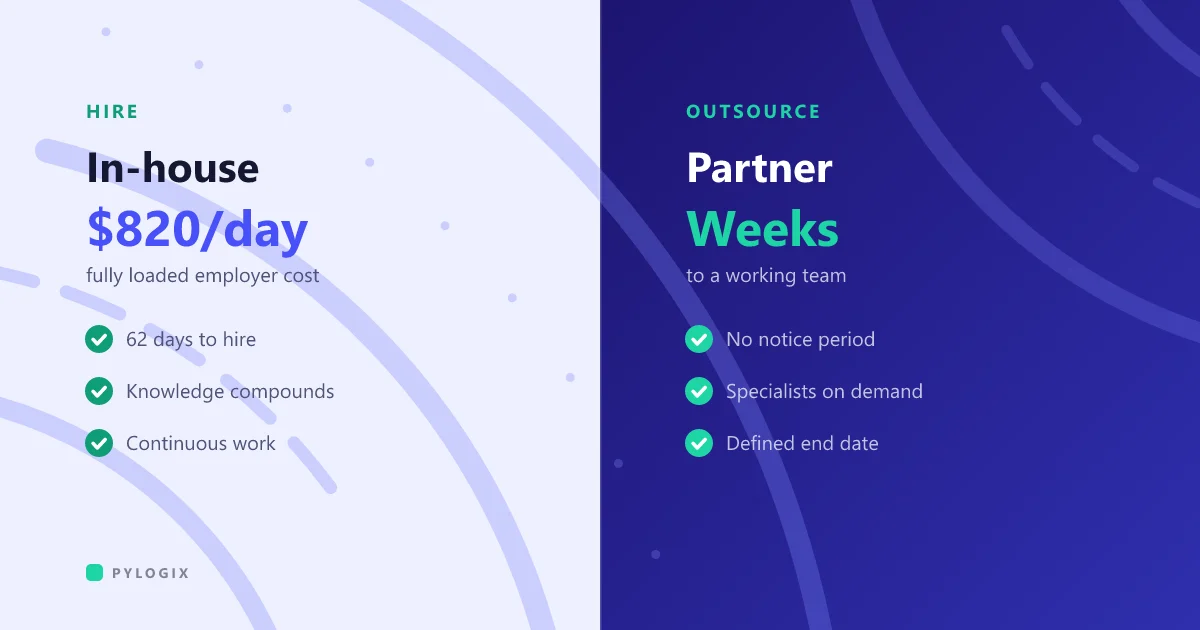
| Cost per working day | $194,257 ÷ 237 | $820 |
So the honest comparison against an agency rate is $820 a day, not the $523 you get from dividing salary by 260. And $820 still excludes recruiting fees, equipment, software licences, workspace, training and the management time to run the person.
The cost nobody puts in the spreadsheet
Money is the easy part. Time is where the decision usually turns.
Recruiting benchmarks for 2026 put the average time to hire for engineering roles at around 62 days, and senior or staff-level engineers routinely run 60 to 90 days or more, because the people you want are not applying for jobs. Add a notice period, then the weeks before someone is contributing at full speed in an unfamiliar codebase.
Where the day-rate comparison misleads in the other direction
Two things favour employment, and they rarely appear in the spreadsheet either.
Knowledge compounds. An employee accumulates understanding of your business that gets more valuable every year. An external team’s understanding leaves when the engagement ends, unless you insisted on documentation and handover throughout. That is a contract term, not a hope, and it is the most common failure in outsourced work.
Attention. Your staff work on your problems all day. An agency team divides attention across clients, however well it is managed. For work that needs sustained deep context over years, that difference is real.
And two favour outsourcing.
You cannot hire one of each. A typical build needs backend, frontend, mobile, infrastructure, design and testing. Hiring one specialist per discipline is unaffordable for most companies, so in practice you hire two generalists and they cover everything, some of it outside their strength. An external team can put a specialist on the work for the two weeks it actually needs one. This is about access to range, not about price.
Being wrong costs less. If a permanent hire does not work out, you carry months of salary and a difficult process. If an engagement does not work out, you end it. That asymmetry is worth real money when the shape or duration of the work is uncertain.
When each one wins
Hire
- Software is your product, so the ability to build it is the company rather than a cost centre
- The work is continuous with no natural end point
- Domain knowledge is the hard part and takes months to absorb
- You already have technical leadership who can hire well and review work
- Regulation restricts who may touch production data
Outsource
- The project has a defined scope and an end: a replatform, an integration, a first release
- You need a skill for weeks rather than years
- You need to start now and cannot absorb a 62-day search
- You are validating something that may not survive contact with the market
- Your team is good and already fully committed
The arrangement most companies land on
The setup that works most reliably is neither option in its pure form. You keep a small permanent core, usually a technical lead plus one or two developers who hold the domain knowledge and own architectural decisions. You bring in external capacity for defined pieces of work and for specialisms you cannot justify employing.
The core keeps the knowledge in the building. The external team supplies range and the ability to scale up and down. It works on one condition: your internal lead has to genuinely lead. If nobody inside can evaluate the work, you are not managing a supplier, you are trusting one.
If you have no internal technical capability and are about to commission something significant, hire or contract one experienced person to represent your interests first, even part-time. That one appointment usually pays for itself on the first project, because it is the difference between buying software and buying a proposal.
Making outsourcing work if you choose it
- Own the accounts. Repository, cloud infrastructure and domains in your name, with the supplier granted access. Not the reverse.
- Require documentation as the work proceeds, not as a final deliverable that gets cut when the deadline tightens.
- Ask for working software on a regular cadence, not a status report. A demo is harder to fake than a percentage.
- Keep one person internally accountable with authority to decide quickly. Slow decisions on your side cost more than most technical problems.
- Agree the handover at the start: what transfers, in what form, and what support exists afterward.
Our checklist on choosing a development partner covers what to ask before signing, and what custom software actually costs sets out where the budget goes.
The short answer
If software is your product and the work never ends, build a team. If you have a defined project, a deadline, or a skill gap you cannot justify filling permanently, buy the capability and keep the knowledge. Most companies need both at different times, and the mistake is treating it as a permanent identity rather than a decision made per piece of work.
If you want a second opinion on which side of that line your project sits, tell us what you are planning. If the answer is that you should hire rather than outsource, we will say so.
Common questions
Is outsourcing software development cheaper than hiring?
Not on rate alone, and the usual comparison is wrong. A median US developer costs an employer roughly $194,257 a year once benefits and payroll taxes are included, which is about $820 per available working day before overhead. Outsourcing wins on speed to start, on access to specialists you cannot justify employing, and on the cost of being wrong. Employment wins when the work is continuous and domain knowledge compounds.
How long does it take to hire a software engineer?
Recruiting benchmarks for 2026 put engineering roles at around 62 days to hire on average, with senior and staff engineers often taking 60 to 90 days or more. Add notice period and ramp-up and the realistic gap between deciding to hire and getting full output is several months.
What should we keep in-house if we outsource the build?
Ownership of the accounts, the architectural decisions, and at least one person who understands the system well enough to evaluate the work. Keep the domain knowledge and the decision rights internal even when the implementation is external.
Sources
- US Bureau of Labor Statistics, Occupational Outlook Handbook: Software Developers. Median annual wage $135,980, May 2025.
- US Bureau of Labor Statistics, Employer Costs for Employee Compensation, June 2026. Private industry: wages 70.0% of employer costs, benefits 30.0%.
- Time-to-hire benchmarks for engineering roles, 2026, averaging approximately 62 days, with senior and staff roles running 60 to 90 days or longer.
Figures were current at the time of writing (September 2026).