
Customer support is where most companies first try generative AI, for good reasons. The volume is high, many questions repeat, the answers are written down somewhere, and the cost of a person handling each one is easy to measure. It is also where the first public failures happened.
Here is what a support bot costs, the arithmetic for when it pays off, and the jobs it should and should not be given.
What the vendors charge
The market has settled on pricing per resolution rather than per seat or per message. You pay when the bot closes a conversation, not when it tries.
| Product | Published or reported price | What counts |
|---|---|---|
| Intercom Fin | $0.99 per outcome, published | Customer confirms it is solved, stops asking for help after the answer, or Fin completes a workflow including a handoff. Charged once per conversation. |
| Zendesk AI agents | About $1.50 on a committed plan and $2.00 pay as you go, as reported by third parties | An automated resolution, with an allowance included per agent seat before charges start |
| Build your own on a model API | Model usage plus engineering, see below | Whatever you decide, which is both the advantage and the risk |
Read the definition of a resolution before the price. “The customer stopped asking for help after the bot replied” includes the customer who gave up and phoned instead, or left. Ask the vendor how they distinguish those, and sample billed resolutions yourself in the first month.
When a bot pays for itself
Start from what a person costs. The Bureau of Labor Statistics puts the median wage for US customer service representatives at $21.53 an hour as of May 2025. Wages are 70% of employer costs in private industry, so the full cost per hour worked is about $30.76, or 51 cents a minute.
Divide each bot price by that, and you get the handling time at which the bot breaks even:
Most support conversations take a person longer than two minutes once you include reading the history, looking up the order and writing the reply. On paper, the bot wins nearly every time. The arithmetic is not where projects fail.
A worked example with the assumptions written down. Five thousand conversations a month. Suppose the bot genuinely resolves 40% of them, and a person would have spent six minutes on each. That is 2,000 resolutions at $0.99, $1,980 a month, against about $6,150 of staff time. The 40% and the six minutes are assumptions, and they are the numbers to measure in a pilot before you trust the saving.
What it costs to build your own
The model calls are the cheap part. We did the arithmetic in what it costs to run an LLM feature in production: a thousand questions a day runs from roughly $51 to $1,185 a month depending on the model. The rest is engineering, and it is where the money goes:
- Retrieval over your own content, so answers come from your policies and help articles rather than the model’s general knowledge. The trade-offs are in RAG, fine-tuning or prompting.
- Connections to your systems, so “where is my order” gets the real order. This is usually the largest piece of work and the one that makes the bot useful.
- Handoff to a person with the full conversation attached, so the customer never repeats themselves.
- Evaluation, a set of real questions with known good answers that every change is tested against. A bot’s answers vary from run to run, which we covered in how to test software that gives a different answer every time.
- Data protection, because support conversations are full of personal data. See building an AI feature on your own data without leaking it.
Building makes sense when the bot has to act inside your own systems in ways an off-the-shelf product cannot reach, or when conversation volume makes per-resolution pricing expensive. For a standard help desk with a decent knowledge base, buying is usually faster and cheaper. The general version of that decision is in build or buy.
What to give the bot, and what to keep
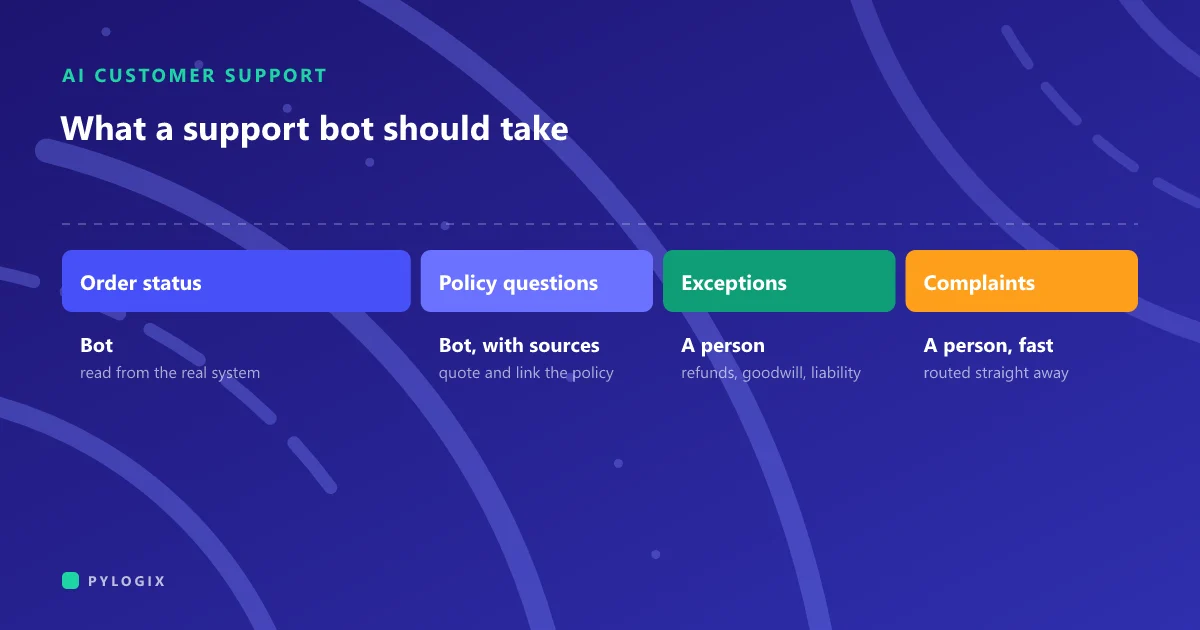
Good bot work
- Order and delivery status, read from the real system
- Password resets and account access, through a secure flow
- Questions answered by a written policy, with the policy linked
- How-to questions covered by your help articles
- Collecting details before a person takes over
Keep with people
- Exceptions to policy: refunds outside the rules, goodwill gestures
- Anything where a wrong answer creates a legal commitment
- Complaints and upset customers, routed fast
- Bereavement, health, money trouble, anything sensitive
- Questions your documentation does not answer
You own what the bot says
In February 2024, the Civil Resolution Tribunal of British Columbia decided Moffatt v. Air Canada. The airline’s website chatbot told a grieving customer he could claim a bereavement fare refund after travelling. The actual policy said otherwise. Air Canada argued the chatbot was responsible for its own words. The tribunal rejected that, found negligent misrepresentation, and ordered the airline to pay $812.02 including $650.88 in damages.
The sum was small. The principle was not: a business is responsible for information on its website whether it comes from a static page or a chatbot. Two design rules follow. The bot quotes and links the actual policy rather than paraphrasing it, and it does not answer questions about money, eligibility or obligations it has no source for. It hands over instead.
Why “replace the support team” keeps failing
The projects that work treat the bot as a first line that clears the repetitive volume and hands everything else to people who now have more time for it. The projects that fail set a headcount target first and then discover that the remaining conversations are the hard ones, that customers notice when they cannot reach a person, and that someone still has to maintain the knowledge base the bot depends on.
Your knowledge base decides the bot’s ceiling. If your help articles are out of date, contradict each other or do not exist, the bot will be confidently wrong in exactly the same ways. Most support bot projects are, in practice, a documentation project first.
A sensible way to start
- Pull three months of conversations and sort them by topic. Find the five topics that make up the most volume and check whether each has a written, current answer.
- Fix the documentation for those five before switching anything on.
- Pilot on those topics only, with every other question going straight to a person.
- Measure real resolution, not billed resolution: did the customer come back within a week about the same thing?
- Widen the scope one topic at a time, only when the last one holds up.
We build AI features that work inside existing custom software, including support assistants that read real order and account data and hand over cleanly. See our AI and machine learning development work, or tell us what your support volume looks like and we will tell you honestly whether to buy, build or wait.
Common questions
How much does an AI customer support chatbot cost?
Off-the-shelf support bots are usually priced per resolved conversation. Intercom publishes $0.99 per outcome for its Fin agent. Zendesk does not publish a list price, and third-party reports put its automated resolutions at about $1.50 on a committed plan and $2.00 pay as you go. Building your own costs model usage, often tens to hundreds of dollars a month, plus the engineering to connect it to your systems, which is the larger cost.
When does a support chatbot pay for itself?
A US customer service representative costs an employer about $30.76 an hour, or 51 cents a minute, based on the BLS median wage of $21.53 and wages being 70% of employer costs. At $0.99 per resolution, a bot breaks even on any conversation a person would spend more than about two minutes on, provided it genuinely resolves it rather than the customer giving up.
Is a company liable for what its chatbot says?
In Moffatt v. Air Canada, decided in February 2024, a British Columbia tribunal held the airline liable for a bereavement refund policy its chatbot described incorrectly, rejecting the argument that the chatbot was responsible for its own statements. The airline paid $812.02. Treat what the bot says as what your company says, and have it quote and link real policies.
Can an AI chatbot replace a customer service team?
Not in the way most plans assume. Gartner predicts that by 2027, half of the organizations that planned to significantly reduce their customer service workforce because of AI will abandon those plans, and in a 2025 survey of 321 service leaders only 20% reported AI-driven headcount reduction. Bots work best as a first line that clears repetitive questions and hands everything else to people.
Sources
- Intercom, pricing page, retrieved November 2026: Fin AI agent $0.99 per Fin outcome. An outcome is counted when a customer confirms the issue is resolved, stops asking for help after Fin responds, or Fin completes a workflow including handoffs, charged once per conversation.
- Zendesk does not publish a per-resolution list price. The $1.50 committed and $2.00 pay-as-you-go figures are as reported by several third-party pricing analyses in 2026, including Intercom’s own comparison guide. Confirm against a Zendesk quote.
- US Bureau of Labor Statistics, Occupational Employment and Wage Statistics, May 2025: customer service representatives (43-4051), median hourly wage $21.53, median annual wage $44,770, employment 2,595,750.
- US Bureau of Labor Statistics, Employer Costs for Employee Compensation, June 2026: wages and salaries 70.0% of private industry employer costs.
- Moffatt v. Air Canada, 2024 BCCRT 149, Civil Resolution Tribunal of British Columbia, 14 February 2024: total award $812.02, comprising $650.88 in damages, $36.14 in pre-judgment interest and $125 in tribunal fees.
- Gartner, press release, 10 June 2025: by 2027, 50% of organizations that expected to significantly reduce their customer service workforce will abandon these plans. Based on a poll of 163 customer service and support leaders.
- Gartner, press release, 2 December 2025: survey of 321 customer service leaders, of whom 20% reported AI-driven headcount reduction.
- The 40% resolution rate and six-minute handling time in the worked example are illustrative assumptions, not measured figures.
Written November 2026. Vendor pricing changes often. Check current terms before comparing.