
Every machine learning proposal contains a sentence like “we have a lot of data”. It is almost always true and almost never the relevant question. What matters is whether the data can answer the specific question the project exists to answer, and that is a much narrower test.
What the evidence actually supports
There is a well-travelled statistic that 85% of machine learning projects fail. It is repeated constantly and sourced thinly, and it belongs in the same category as the claim that late defects cost a hundred times more to fix: directionally believable, numerically folklore. We would rather give you the figures that have a traceable origin.
That second number is the one worth sitting with. It is not a survey of laggards. It is a survey of the people whose job is data management, and most of them could not say with confidence that their practices were adequate for what the business was about to ask of them.
Other figures circulate: RAND has reported an AI project failure rate above 80%, and MIT research in 2025 found that a large majority of enterprise generative AI pilots produced no measurable effect on profit and loss. Both are real studies and both have been stretched well past what they measured in the retelling. Treat any single percentage in this space as an argument someone is making rather than a fact, including the ones above.
The reframe that saves the most money
Gartner’s own definition of AI-ready data is worth reading closely: data aligned to specific use cases, governed at the asset level, supported by automated pipelines with quality gates, managed through live metadata, and continuously quality-assured.
The first clause is doing the work. Readiness is not a property a data estate has. It is a relationship between a dataset and a question.
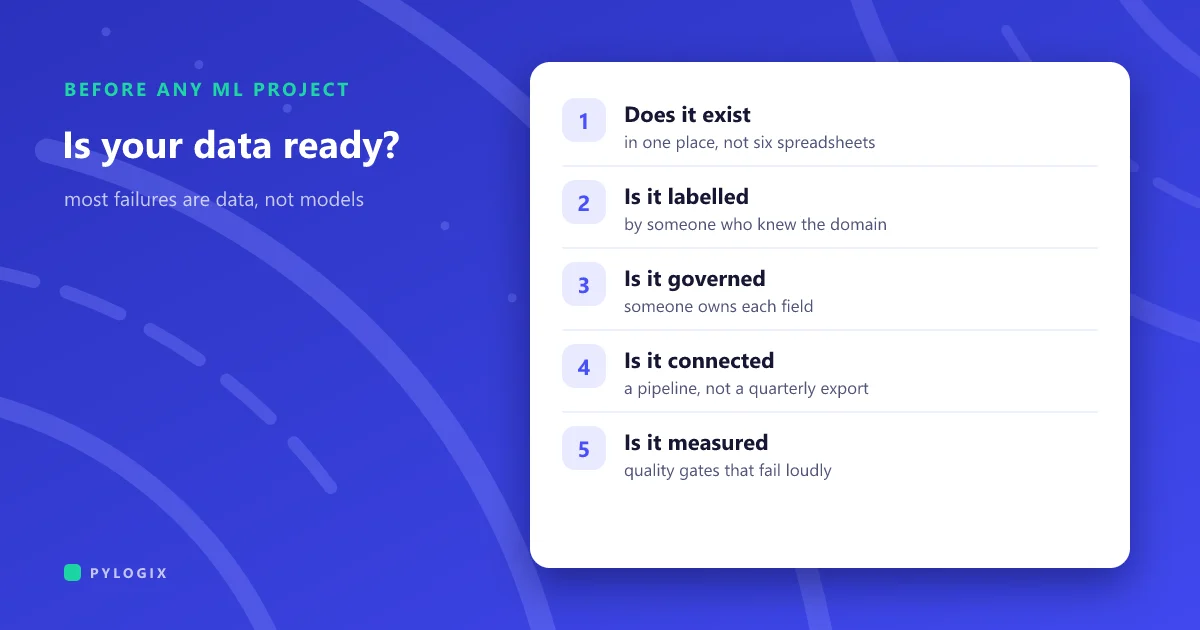
The five questions
1. Does it exist, in one place? Not “do we collect it”. Is it retrievable by a system rather than a person. Data spread across six spreadsheets, a legacy database and one colleague’s judgement exists in the sense that matters to the business and not in the sense that matters to a model.
2. Is it labelled, and by someone who knew the domain? For anything supervised, label quality is a hard ceiling on model quality, and no amount of modelling gets above it. The common failure is not missing labels, it is labels applied inconsistently by different people over several years against a definition that quietly drifted.
3. Is it governed? Someone owns each significant field and can say what it means, when its meaning last changed and what a null in it signifies. The absence of this is what produces models that learn an artefact of a 2021 process change and then fail quietly in production.
4. Is it connected? A pipeline, not a quarterly export. A model that trains on a snapshot someone emailed is a demonstration. Getting from there to production is mostly this problem, and it is engineering rather than data science.
5. Is it measured? Automated checks on completeness, ranges and distributions that fail loudly and block the pipeline. Without these, the way you find out the upstream schema changed is that predictions get strange three weeks later.
Question three is where most estates actually fail, and it is the least technical of the five. It is a question about whether anyone is accountable for a field’s meaning. That is an organisational answer, which is why data readiness programmes led purely by engineering tend to stall.
“We don’t have enough data” is usually about the wrong task
This objection ends more projects than it should, because the volume required collapsed over the last few years for a large class of problems. It depends entirely on what you are asking for.
If the goal is to let people ask questions of your own documents and contracts and policies, you need no labelled examples. You need documents that are current, findable and permissioned correctly. That is a different readiness problem, and a more tractable one. The architecture choice behind it is covered in RAG, fine-tuning or prompting.
If the goal is genuinely predictive, forecasting demand, scoring risk, predicting churn, then the volume question returns and so does every one of the five above. Being clear which kind of project you are proposing is the cheapest thing you can do at the start.
Three blockers that are not about volume
- Labels that disagree with themselves. Three people classified support tickets over four years against a definition that changed twice. The labels exist and they are worse than none, because they teach the model the inconsistency. Re-labelling a sample and measuring agreement between annotators is the cheapest diagnostic available and almost nobody runs it.
- Permissions discarded at ingestion. The data is fine and the access rules were left behind in the source systems. This does not surface as a data problem, it surfaces as a security incident. We cover the mechanism in building an AI feature on your own data without leaking it.
- No path from the model to a decision. The prediction is accurate and nothing in the business changes as a result, because no process consumes it. This is the most common reason a technically successful pilot produces nothing, and it is not a data problem at all.
What to do before committing budget
- Name one use case, precisely. Not “use AI in operations”. One decision, made by a named person, that a system could inform.
- Work backwards to the data it needs. Which fields, from which systems, at what freshness, for which population. This usually takes a day and frequently ends the project, which is a good outcome at this price.
- Pull a real sample and look at it. Not a schema. Actual rows, counting nulls in the fields that matter, checking date ranges, and finding out how many records fail a rule someone assumed always held.
- If it is supervised, measure annotator agreement. Have two people independently label 100 records. If they disagree on a quarter of them, that is your ceiling and no model will exceed it.
- Cost the pipeline, not the model. Getting the data flowing reliably is most of the work and most of the budget, and it is the part that keeps costing after launch.
This is a discovery phase with a specific shape, and the arguments for not skipping it are the same as everywhere else: see what actually happens in a discovery phase.
The question worth asking out loud
Does this need machine learning at all? A meaningful share of projects that arrive framed as prediction problems are answered better by a rule, a report or a better-designed form. Those are cheaper, explainable, testable with ordinary tools, and they do not need any of the five conditions above.
Being willing to reach that conclusion is what separates a data readiness assessment from a sales process. More on where the line sits in where AI actually pays off in business software, and on what it costs once it is running in what it costs to run an LLM feature in production.
Our AI and machine learning team runs this assessment as a fixed piece of work, and we will tell you when the answer is a report rather than a model. If you have a use case in mind and no idea whether your data supports it, describe the decision you want to improve.
Common questions
What does AI-ready data mean?
Gartner defines it as data aligned to specific use cases, governed at the asset level, supported by automated pipelines with quality gates, managed through live metadata and continuously quality-assured. The first clause is the important one: readiness is a relationship between a dataset and a question, not a property a data estate can have on its own. The same warehouse can be ready for one use case and unusable for the next.
How much data do you need for a machine learning project?
It depends entirely on the approach. Training a model from scratch needs tens of thousands of labelled examples or more. Fine-tuning an existing model needs hundreds to a few thousand. Retrieval over your own documents needs no labelled examples at all, only documents that are current, findable and correctly permissioned. A large share of what companies want to build falls into that last category, which is why “we do not have enough data” is often answering the wrong question.
Why do machine learning projects fail?
Most often for reasons upstream of the model: labels that disagree with themselves because the definition drifted over the years, no reliable pipeline so the system never leaves the demonstration stage, no owner who can say what a field means, and no business process that consumes the prediction. Gartner predicts 60% of AI projects unsupported by AI-ready data will be abandoned through 2026, and found 63% of data management leaders unsure their practices are adequate.
How do you assess whether data is good enough for AI?
Name one specific use case, work backwards to the exact fields and freshness it needs, pull a real sample and count nulls and rule violations rather than reading the schema, and if the task is supervised have two people independently label a hundred records and measure how often they agree. That agreement rate is your accuracy ceiling. The whole exercise takes days, not months, and it frequently ends the project cheaply.
Sources
- Gartner, Lack of AI-Ready Data Puts AI Projects at Risk, press release, 26 February 2025: Gartner predicts that through 2026 organisations will abandon 60% of AI projects unsupported by AI-ready data. A third quarter 2024 survey of 248 data management leaders found 63% either do not have or are unsure whether they have the right data management practices for AI. Commentary from Roxane Edjlali, Senior Director Analyst.
- Gartner’s definition of AI-ready data as aligned to specific use cases, governed at asset level, supported by automated pipelines with quality gates, managed through live metadata and continuously quality-assured, from the same research.
- The frequently quoted claim that 85% of machine learning projects fail is repeated far more often than it is sourced and is not used as a factual basis here. RAND has published an AI project failure rate above 80%, and MIT research in 2025 reported that most enterprise generative AI pilots showed no measurable profit and loss impact. Both have been widely stretched beyond what they measured.
- Figures in the second chart are orders of magnitude, not measurements. The requirement varies by task difficulty, class balance and how much a pretrained model already knows about the domain.
Written September 2026.